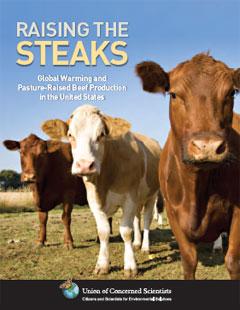
Major findings of this report include:
the use of pasture management practices that improve the nutritional quality of forage crops could reduce methane emissions from pasture beef by about 15 to 30 percent. However, some grazing lands would not benefit from these practices, so overall reductions in U.S. global warming emissions would be considerably less than 0.5 percent—or one-third of the 1.4 percent of emissions that now come from beef production by applying these practices where appropriate.
the use of better management practices on pastures that have not been well managed, or the conversion of crop acres to pasture, could allow pastures to sequester about 0.8 to 1.0 metric ton of carbon per hectare. Better management practices on pasture could offset 0.1 to 2 percent of annual U.S. heat-trapping emissions, depending on which practices land managers adopt. Converting croplands to pasturelands could increase that amount, but new practices may involve tradeoffs in heat-trapping gases that need to be considered. In many areas, soil could continue to add carbon for several decades—until the rate at which soil loses carbon equals the rate at which it accumulates. Land managers must sustain the practices they use to enhance carbon sequestration, or soil could release the stored carbon back into the atmosphere. Best management practices used to grow crops, such as no-till methods for corn used in beef CAFOs, sequester about only half as much carbon as well-managed pasture. And only about 20 to 25 percent of U.S. corn acres now rely on no-till farming—a practice often linked to greater carbon sequestration.
best management practices available now that can reduce the climate change impact of pasture beef include:
other innovative practices that may have climate benefits include:
Further research is needed to better quantify the cuts in global warming emissions from all these practices. Several other practices that optimize grazing and pasture growth— including managed rotational grazing, which entails moving grazing cattle among fenced pasture areas frequently— seem promising but also require more research. And the possible synergies of integrating several promising practices would particularly benefit from further analysis.
Fonden The Savory Foundation is incorporated in Denmark, with offices in Copenhagen, Madrid, and Punta del Este. CVR-nr: 43597205
Savory Institute is a U.S.-registered 501(c)(3) non-profit organization. EIN: 45-4134319
Land to Market is a U.S. public-benefit corporation with majority ownership by the Savory Institute. EIN: 88-2589299
885 Arapahoe Ave, Boulder, Colorado 80302 | contact@savory.global