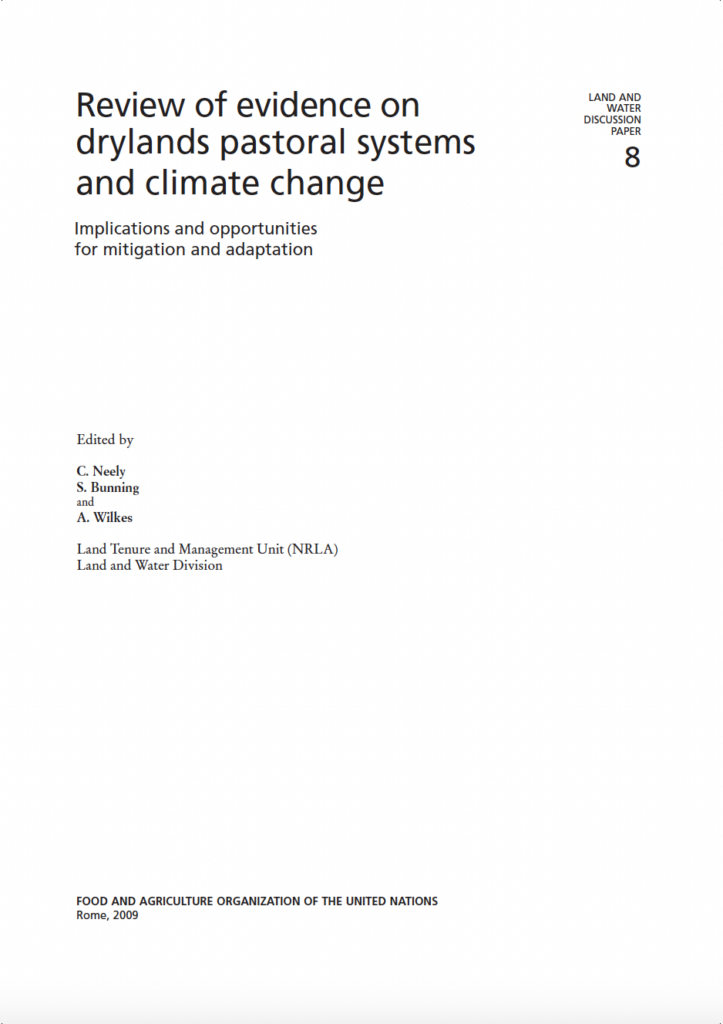
In light of global concerns over the impacts of climate change and climate variability, this document provides an overview of opportunities for adaptation and mitigation in dryland pastoral and agropastoral systems. It makes a case for a concerted global effort to promote mitigation practices that also have benefits for adaptation and livelihoods of pastoralists and agropastoralists in drylands.
This review first highlights the importance of drylands, grazing lands and livestockbased livelihoods and illustrates the interrelations between climate change, land and livestock. It then provides estimates of the potential carbon storage and sequestration in pasture and rangelands in drylands and outlines the main land management measures for improving carbon cycling and grassland management. The socio-economic dimensions of rangeland management and the climate change adaptation and associated co-benefits are then highlighted. In conclusion, it presents some key messages on the importance of grasslands and rangelands in terms of their contribution to carbon sequestration and to the livelihoods of the poor. It highlights the fact that management strategies and practices that contribute to mitigating climate change will also play a major role in climate change adaptation and reducing vulnerability to natural disasters for the millions of people – including the poor – who depend on these land-use systems. Finally, it provides some suggestions on ways forward in light of the current policy framework and climate change negotiations.
The review also highlights the vast untapped potential for climate change mitigation and adaptation associated with improved carbon sequestration in pastoral systems and rangelands. Much of this potential lies in soil carbon sequestration. Its neglect during the Kyoto process1 stemmed from concerns regarding perceived difficulties of measurement and monitoring due to soil spatial variability, and of ensuring permanence (IPCC, 2008). Recent negotiations have highlighted the potential for Reducing Emissions from Deforestation and Forest Degradation (REDD) and for carbon sequestration in soils and above-ground biomass in other lands besides forests. Evidence regarding the potential for carbon sequestration in rangelands and grasslands is continually accumulating. The review demonstrates that there is a strong justification for a concerted international process to explore and support efforts for achieving carbon sequestration and promoting sustainable (agro)-pastoral livelihoods in dryland systems through the ongoing post-Kyoto deliberations and negotiations.
Fonden The Savory Foundation is incorporated in Denmark, with offices in Copenhagen, Madrid, and Punta del Este. CVR-nr: 43597205
Savory Institute is a U.S.-registered 501(c)(3) non-profit organization. EIN: 45-4134319
Land to Market is a U.S. public-benefit corporation with majority ownership by the Savory Institute. EIN: 88-2589299
885 Arapahoe Ave, Boulder, Colorado 80302 | contact@savory.global