
Whole-System Approach Managing Grazing to Restore Soil Health and Farm Livelihoods

This paper is a literature review on the ecological impacts of grazing, and finds that where managed properly (employing a “whole-systems approach” and “adaptive, goal-directed grazing methods”) livestock are essential to ecosystem service sustainability and improvement. Soil organic matter increases were sufficient to yield a net sink of 2 tons of carbon per hectare per year.
The Reindeer Chronicles
The Reindeer Chronicles demonstrates how solutions to seemingly intractable problems can come from the unlikeliest of places, and how the restoration of local water, carbon, nutrient, and energy cycles can play a dramatic role in stabilizing the global climate. Ultimately, it reveals how much is in our hands if we can find a way to work together and follow nature’s lead.
It’s Not the Cow, It’s the How
In this thought-provoking talk, Bobby Gill of the Savory Institute discusses the symbiosis between grasslands and grazer, and why everyone — regardless of dietary choice — depends on properly-managed livestock for regenerating these dying landscapes.
A half-century of Holistic Management: what does the evidence reveal?
This comprehensive literature review describes the main tenets of HM and addresses the longstanding and unresolved controversy over its legitimacy. It additionally provides a meta-analysis that not only provides an up-to-date review of the multidisciplinary evidence and ongoing arguments about HM, but also provides a novel explanation for the controversy.
Impacts of holistic planned grazing with bison compared to continuous grazing with cattle in South Dakota shortgrass prairie
Paper assesses Holistic Planned Grazing outcomes in shortgrass prairie of the Northern Great Plains of North America. Researchers compared key ecosystem functions on the ranch of long time Holistic Management practitioner Mimi Hillenbrand who grazes bison, with those on neighboring cattle ranches using set stocked light continuous (LCG) and heavy continuous grazing (HCG).
Carbon Footprint Evaluation of Regenerative Grazing at White Oak Pastures
Lifecycle analysis on White Oak Pastures’ beef. Results demonstrated that a pound of protein sequestered 3.5 pounds of CO2, in comparison to conventional beef which emitted 33 pounds of CO2 per pound of protein, or even Impossible Burger or Beyond Meat which emitted 3.5 pounds and 2 pounds of CO2 per pound of protein, respectively.
Water in Plain Sight
Animated by stories from around the globe, Water In Plain Sight is an inspiring reminder that fixing the future of our drying planet involves understanding what makes natural systems thrive. In this timely, important book, Judith D. Schwartz presents a refreshing perspective on water that transcends zero-sum thinking. By allying with the water cycle, we can revive lush, productive landscapes, like the river in rural Zimbabwe that now flows miles further than it has in living memory thanks to restorative grazing; the fruit-filled food forest in Tucson, Arizona, grown by harvesting urban wastewater; or the mini-oasis in West Texas nourished by dew.
Reassessing the role of grazing lands in carbon-balance estimations: Meta-analysis and review

This study compared the carbon balance reported by national inventories that followed the IPCC, with an alternative estimation derived from the meta-analysis of science-based, peer-reviewed data. Results show that the potential for grasslands to sequester carbon is large and unaccounted for in standard IPCC models.
Kiss the Ground
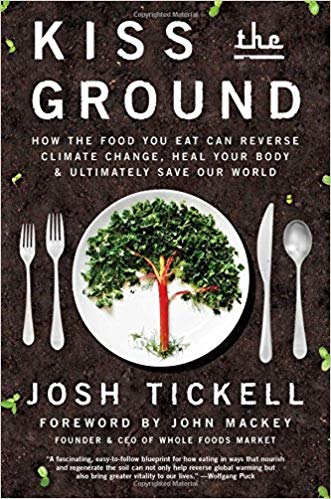
This “richly visual” look at the impact of an underappreciated but essential resource—the very ground that feeds us—features fascinating and accessible interviews with celebrity chefs, ranchers, farmers, and top scientists. Kiss the Ground teaches you how to become an agent in humanity’s single most important and time-sensitive mission: reverse climate change and effectively save the world—all through the choices you make in how and what to eat. Also a full-length documentary executive produced by Leonardo DiCaprio and narrated by Woody Harrelson.
Profile of good stewardship: the Rafter F Cattle Company (2001)

This case study of a ranch in New Mexico, USA by the Quivira Coalition features Rafter F Ranch—a 4,779-hectare property in San Jon, New Mexico. Net income per acre grew from $5.84 in 1984 to $22.5 in 1992.
