
Impacts of holistic planned grazing with bison compared to continuous grazing with cattle in South Dakota shortgrass prairie

Paper assesses Holistic Planned Grazing outcomes in shortgrass prairie of the Northern Great Plains of North America. Researchers compared key ecosystem functions on the ranch of long time Holistic Management practitioner Mimi Hillenbrand who grazes bison, with those on neighboring cattle ranches using set stocked light continuous (LCG) and heavy continuous grazing (HCG).
Water in Plain Sight

Animated by stories from around the globe, Water In Plain Sight is an inspiring reminder that fixing the future of our drying planet involves understanding what makes natural systems thrive. In this timely, important book, Judith D. Schwartz presents a refreshing perspective on water that transcends zero-sum thinking. By allying with the water cycle, we can revive lush, productive landscapes, like the river in rural Zimbabwe that now flows miles further than it has in living memory thanks to restorative grazing; the fruit-filled food forest in Tucson, Arizona, grown by harvesting urban wastewater; or the mini-oasis in West Texas nourished by dew.
Cell Grazing – The First 10 Years in Australia
This paper tracks the progress of Cell Grazing in Australia from 1990 when it was first taught, to 1999, from 2 perspectives. Cell Grazing was found to boost business profitability and improve soil as well as to increase rainfall use efficiency and, usually, biodiversity. Described as a high-level, time-control grazing method, Cell Grazing differs from a variety of rotational grazing systems.
Effect of grazing on soil-water content in semiarid rangelands of southeast Idaho
This papers shows that soils under a grazing method called “simulated holistic planned grazing” have the highest percent volumetric-water content of soils tested under three different grazing methodologies that also included “rest-rotation”, and “total rest”. Although this study was a simulation, it demonstrates the potential for soils managed with Holistic Planned Grazing to increase their water-holding capacity.
Cows Save the Planet
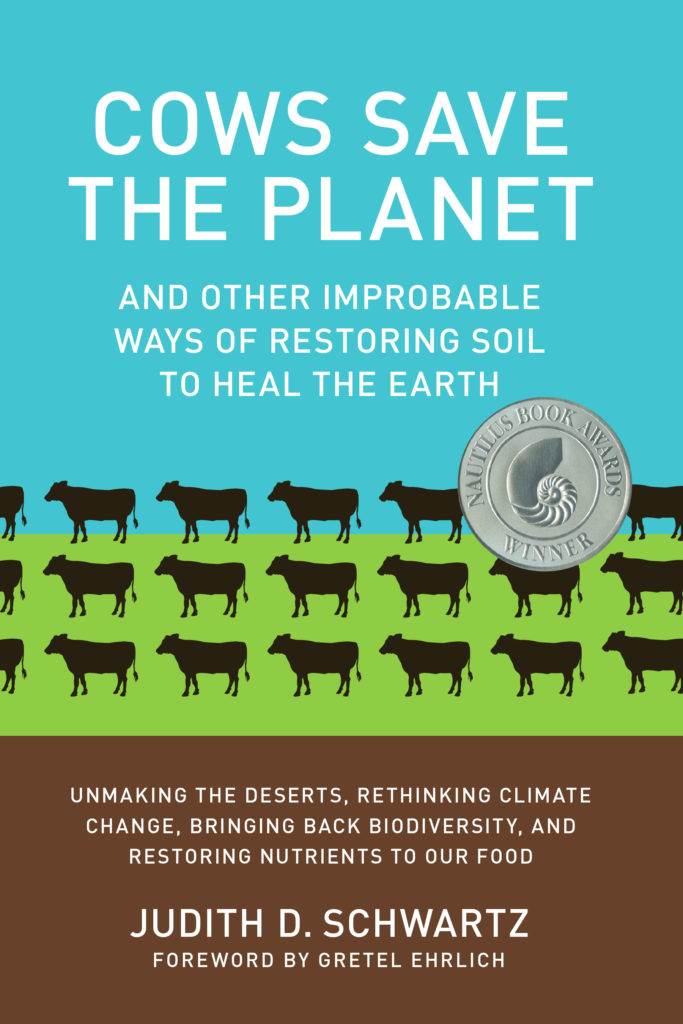
In Cows Save the Planet, journalist Judith D. Schwartz looks at soil as a crucible for our many overlapping environmental, economic, and social crises. Schwartz reveals that for many of these problems – climate change, desertification, biodiversity loss, droughts, floods, wildfires, rural poverty, malnutrition, and obesity – there are positive, alternative scenarios to the degradation and devastation we face.
Twodot Land and Livestock – Pushing Limits on the Northern Plains

Fourth generation Montanan rancher and second generation Holistic Management practitioner continues to push the envelope while simultaneous increasing profits, cultural well being, and ecological resiliency. While still doing holistic grazing planning, in 2006, Zach pastured a fairly conventional four herds—three groups of yearlings (750 head, 440 head, and 500 head), plus a herd of 400 cows. In 2007, Jones invested in water development in order to combine all the yearlings into one big herd of 1,550 head. This herd was on Zachary’s 12,000 acres all summer (mid-May to mid-September), as well as a year round herd of 500 cows.
Resiliency Down Under Drought-Proofing in New South Wales
In 2006-2007, southern Australia faced historic drought conditions, with the Coughlin family’s Tarabeh property receiving 8 of the 17-inch average, and Moombril receiving 10.5 of the normal 30. They survived the drought with more cattle than they started and without buying a pound of hay. This case study details the conditions they faced and the tough decisions that were made to make it through.
The Whitten Ranch – Creating More with Less
This case study is an excerpt from Jim Howell’s 2008 book, For the Love of Land: Global Case Studies of Grazing in Nature’s Image. Following George Whitten of the San Luis valley in Colorado, Howell states “Fifteen years after taking his first Holistic Management course, he has figured out how to get by on a fraction of his former water use. He has increased the biodiversity and vigor of his irrigated meadows and hilly native rangeland to a plant mix that can thrive even in dry years.”
Surviving or Thriving in Drought
Analyzing ecological monitoring data from 1999 to 2007, Tony Malmberg of Twin Creek Ranch and Jim Howell assess how Twin Creek’s drought-induced management adjustments enabled them to maintain the integrity of their ecosystem processes. Malmberg also discusses his “ah-ha” moment after hearing Howell’s hypothesis that low production, brittle environments likely evolved under grazing patterns with longer (sometimes multi-year) recovery periods compared to brittle environments with higher production.
N.D. Rancher Builds Biological Capital
This 2009 article in Beef Producer magazine follows Gene Goven and his 1,500-acre ranch in South Dakota, USA. Researchers have documented that grasses penetrating only 3 to 5 inches,now send down roots four to 10 times as deep. From 1982 to 2001, water infiltration in his soils increased from 0.8 to 6.2 inches/hour. His grazing season also lengthened, increasing from 150 – 180 days of grazing a year to 230 – 270 days.
