
The Potential of Restorative Grazing to Mitigate Global Warming by Increasing Carbon Capture on Grasslands

This white paper reviews the literature on soil organic carbon losses and potential gains through regenerative management. It finds that most literature is limited to areas considered in “agriculture” and that rangelands may be largely under represented both in terms of of losses and drawdown potential. It argues that with regenerative rangeland practices, such as Holistic Planned Grazing, the total capture of atmospheric carbon may be much higher than previously considered. An upward estimate of 88 to 210 gigatons (billions of tons) of carbon (88-210 GtC) representing a total drawdown of 25 to 60 tons per hectare on 3500 million hectares of grasslands worldwide is postulated as achievable through proper rangeland/grassland management.
777 Buffalo Ranch – South Dakota (2014)

This 2013 case study follows Mimi Hillenbrand of the 28,000-acre 777 Bison Ranch in South Dakota, USA. Among other impressive results, over 20 years bare ground has decreased significantly from 34% to under 10%, there are virtually no signs of erosion, and low production grasses are being replaced by deep-rooted native species like Green Needlegrass and native herbs such as Echinacea.
Africa Centre for Holistic Management Zimbabwean Savanna Case Study
This 2012 case study follows the Africa Centre for Holistic Management in Victoria Falls, Zimbabwe. Between 2001 and 2009, ecologoical monitoring demonstrated a 31% decrease in bare ground, 56% increase in litter cover, 12% increase in perennial grass plants, 21% decrease in less desirable annual grasses, and 17% decrease in soil movement.
Allan Savory’s TED Talk: “How to green the world’s deserts and reverse climate change”
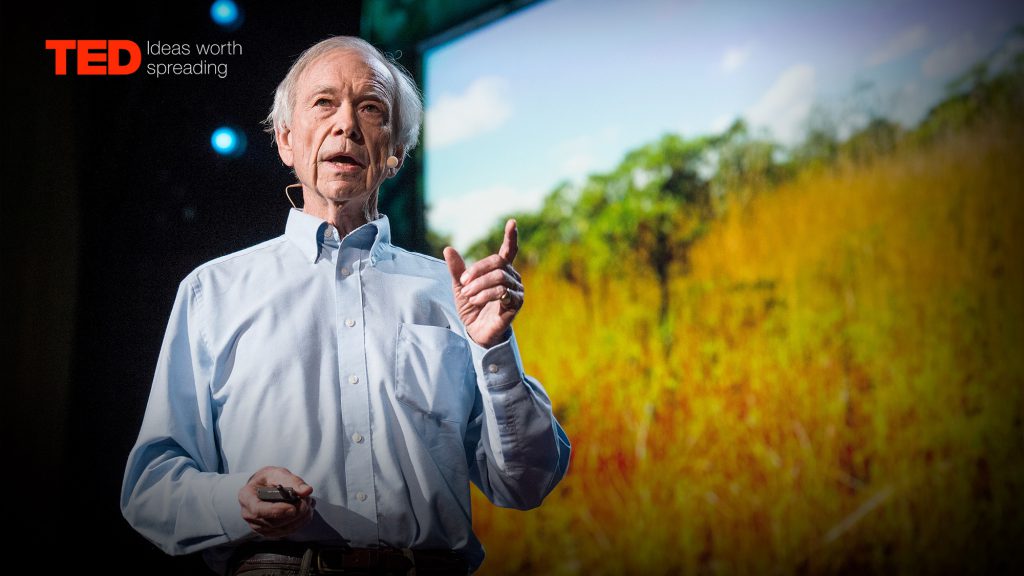
Allan Savory’s famous 2013 TED Talk on the main stage.
Twodot Land and Livestock – Pushing Limits on the Northern Plains
Fourth generation Montanan rancher and second generation Holistic Management practitioner continues to push the envelope while simultaneous increasing profits, cultural well being, and ecological resiliency. While still doing holistic grazing planning, in 2006, Zach pastured a fairly conventional four herds—three groups of yearlings (750 head, 440 head, and 500 head), plus a herd of 400 cows. In 2007, Jones invested in water development in order to combine all the yearlings into one big herd of 1,550 head. This herd was on Zachary’s 12,000 acres all summer (mid-May to mid-September), as well as a year round herd of 500 cows.
Prosperity through Simplicity – The Coughlans of Tarabah
Michael and Anna Coughlin, who manage the 18,000-hectare Tarabah on the plains of southwestern New South Wales, are “among the world’s greatest harvesters of sunlight” according to Howell. The Coughlins also manage the 2,400-hectare Moonbrill property a few hours to the east in a more productive environment… all with just 2.5 full-time employees and close to 6,000 cattle. Despite large tracts of Australia’s perennials reverting to cool season annuals, the Coughlins have created the conditions for pernnials to re-establish, and in doing so the wildlife (including duck-billed platypus and echidnas) has become more abundant.
Resiliency Down Under Drought-Proofing in New South Wales
In 2006-2007, southern Australia faced historic drought conditions, with the Coughlin family’s Tarabeh property receiving 8 of the 17-inch average, and Moombril receiving 10.5 of the normal 30. They survived the drought with more cattle than they started and without buying a pound of hay. This case study details the conditions they faced and the tough decisions that were made to make it through.
The Whitten Ranch – Creating More with Less
This case study is an excerpt from Jim Howell’s 2008 book, For the Love of Land: Global Case Studies of Grazing in Nature’s Image. Following George Whitten of the San Luis valley in Colorado, Howell states “Fifteen years after taking his first Holistic Management course, he has figured out how to get by on a fraction of his former water use. He has increased the biodiversity and vigor of his irrigated meadows and hilly native rangeland to a plant mix that can thrive even in dry years.”
Rancho de la Inmaculada – Prospering in the Desert
At 2500 feet (820 meters) of elevation, the patch of desert embracing La Inmaculada is blessed with an average of 13 inches (330 mm) of annual precipitation. Since the Aguirres have been practicing Holistic Management, annual totals have ranged from 6 to 25 inches. About 50 percent comes during the summer monsoons in July and August, their main growing season. Because there is an almost total absence of cool-season grasses, winter rains do them little good in terms of grass growth, but they do add to the bank of soil moisture critical to brush green-up in the spring.
Surviving or Thriving in Drought
Analyzing ecological monitoring data from 1999 to 2007, Tony Malmberg of Twin Creek Ranch and Jim Howell assess how Twin Creek’s drought-induced management adjustments enabled them to maintain the integrity of their ecosystem processes. Malmberg also discusses his “ah-ha” moment after hearing Howell’s hypothesis that low production, brittle environments likely evolved under grazing patterns with longer (sometimes multi-year) recovery periods compared to brittle environments with higher production.
