
A half-century of Holistic Management: what does the evidence reveal?

This comprehensive literature review describes the main tenets of HM and addresses the longstanding and unresolved controversy over its legitimacy. It additionally provides a meta-analysis that not only provides an up-to-date review of the multidisciplinary evidence and ongoing arguments about HM, but also provides a novel explanation for the controversy.
It’s not the cow, it’s the how (infographic)
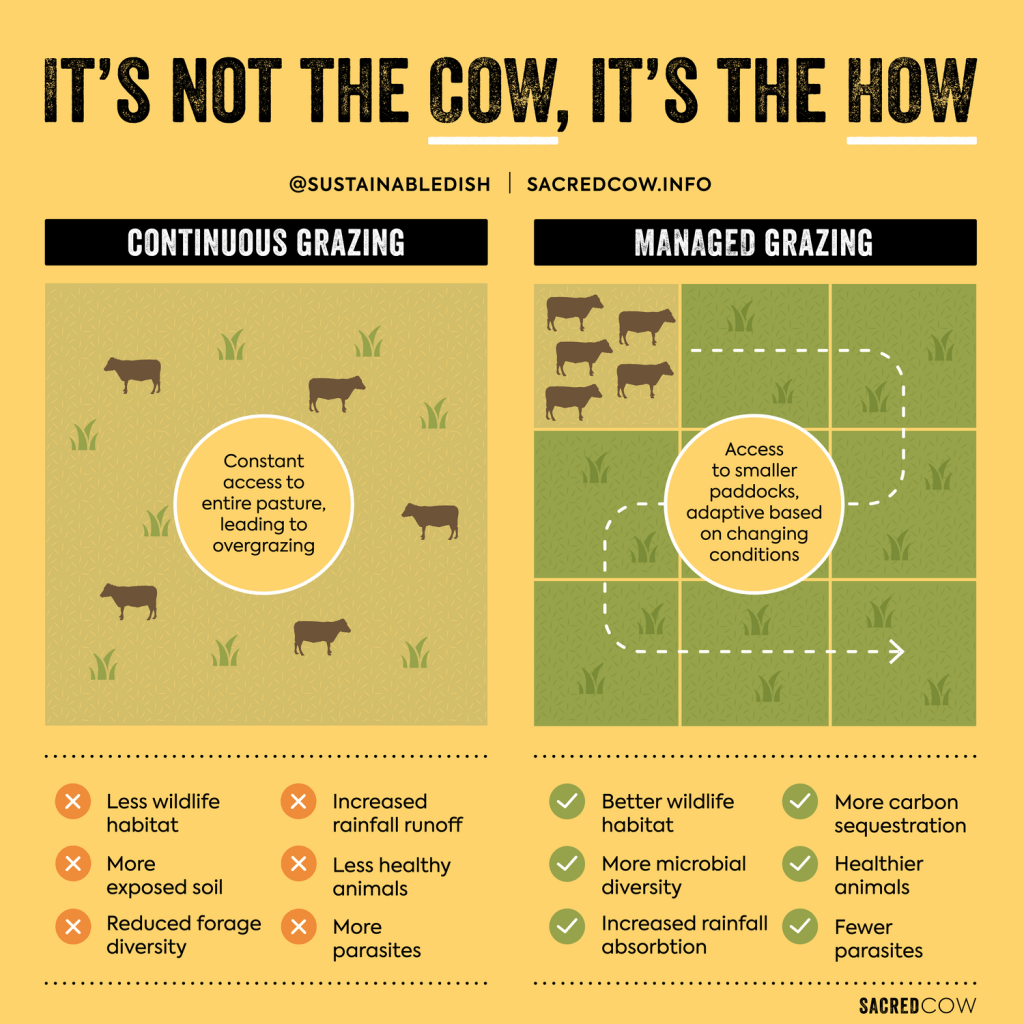
This infographic shows the difference between continuous grazing and managed grazing, a nuance often left out by those advocating against livestock grazing.
Impacts of holistic planned grazing with bison compared to continuous grazing with cattle in South Dakota shortgrass prairie
Paper assesses Holistic Planned Grazing outcomes in shortgrass prairie of the Northern Great Plains of North America. Researchers compared key ecosystem functions on the ranch of long time Holistic Management practitioner Mimi Hillenbrand who grazes bison, with those on neighboring cattle ranches using set stocked light continuous (LCG) and heavy continuous grazing (HCG).
Carbon Footprint Evaluation of Regenerative Grazing at White Oak Pastures
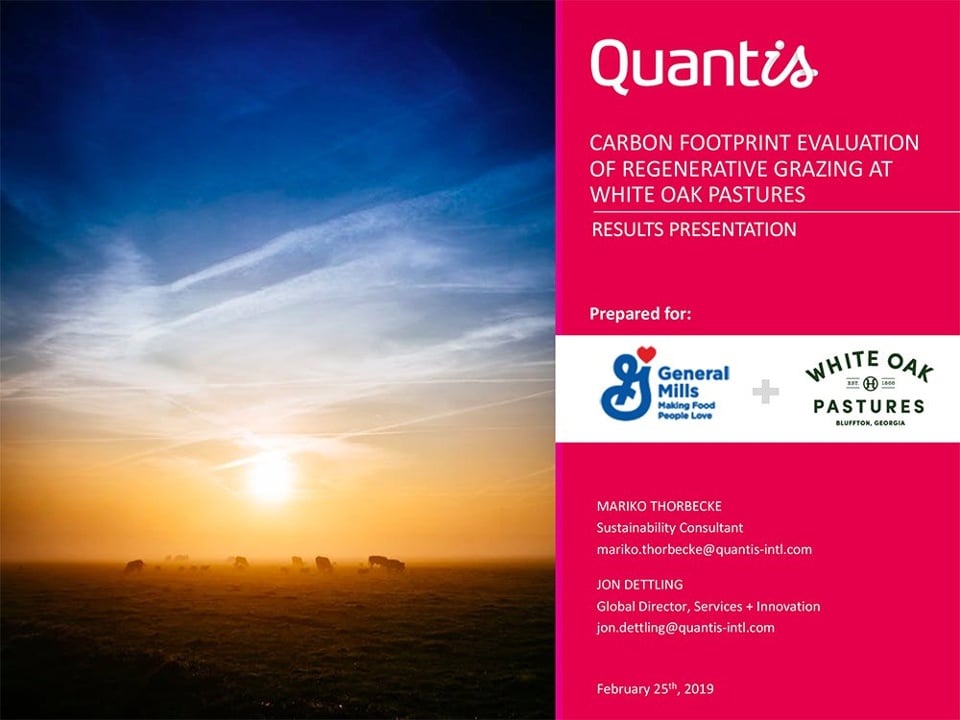
Lifecycle analysis on White Oak Pastures’ beef. Results demonstrated that a pound of protein sequestered 3.5 pounds of CO2, in comparison to conventional beef which emitted 33 pounds of CO2 per pound of protein, or even Impossible Burger or Beyond Meat which emitted 3.5 pounds and 2 pounds of CO2 per pound of protein, respectively.
Holistic Management Handbook, Third Edition
Now in its third edition, Holistic Management Handbook: Regenerating Your Land and Growing Your Profits is the practical workbook for anyone using the planning procedures of Holistic Management.
Effects of holistic grazing management on milk production, weight gain, and visitation to grazing areas by livestock and wildlife in Laikipia County, Kenya
This paper studied the effects of holistic planned grazing on milk production, weight gain, and visitation to grazing areas by livestock and wildlife in Laikipia County, Kenya. Results found that, with significantly higher numbers of grazing animals, the number of wildlife more than doubled, average milk yields increased, and animal weight gain nearly doubled compared to traditional grazing areas.
Deficiencies in the Briske et al. Rebuttal of the Savory Method
In this paper, Dr. Richard Teague examines the shortcomings and inaccuracies of his colleague Dr. David Briske’s claims against Allan Savory’s methods.
Profile of good stewardship: the Rafter F Cattle Company (2001)

This case study of a ranch in New Mexico, USA by the Quivira Coalition features Rafter F Ranch—a 4,779-hectare property in San Jon, New Mexico. Net income per acre grew from $5.84 in 1984 to $22.5 in 1992.
Managing Grass, Small Grains, and Cattle (1992)
The Goven Ranch is an 1800 acre cattle and small grain operation located in McLean county, North Dakota. From 1967 to 1986, Gene Goven practiced different grazing management systems. In 1986, he made the shift to Holistic Management and Holistic Planned Grazing (referred in the article as Holistic Management’s former name, Holistic Resource Management or HRM). One of the first observed changes in land health occurred in cool season plants; the use of grazing planning allowed the grazing of cool season plants early in the season and extended recovery periods, which improved the
vigor and growth of these plants. Additionally, a “leap frog” approach to paddock movements eliminated the need for fly control, as the distance between “cow pies” self-limited fly populations.
Resilience on the Prairie Edge: The 777 Buffalo Ranch (2010)
The health and resilience of the 777 Buffalo Ranch is directly related to the abundance and diversity of its plant and animal species. On the ranch, plant diversity is increasing having many species of native cool and warm season grasses, flowering forbs, shrubs and trees.
